
These recordings are based on manual interpretive work carried out entirely within a DAW, with expressive control achieved through tempo shaping, micro-timing, and dynamic modulation.
Tempo Freedom (Rubato) and Micro-timing
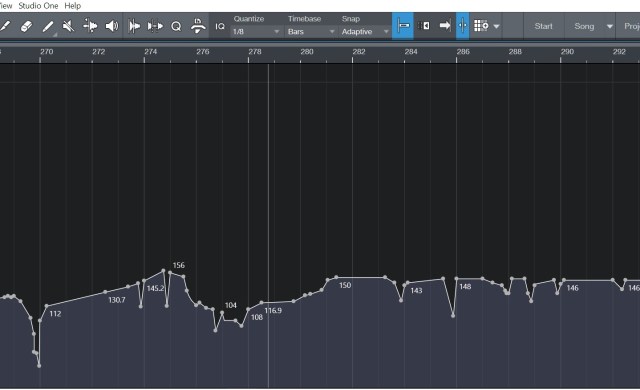
Rubato refers to the flexible temporal manipulation of rhythm in the melody. To achieve this effect, I use manual editing of the tempo curve in Studio One. The tempo graph is rarely static; it is continuously manipulated to reflect the dynamic nature of rubato, to realize the interpretation, and to create a natural sense of musical breathing.
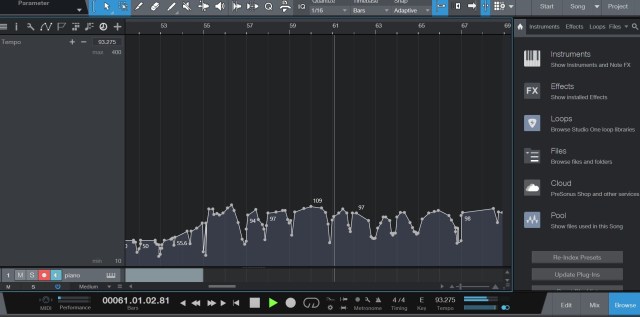
I also use micro-timing (very subtle control of time) as a technical technique to achieve expressive interpretation. I manually place short, sharp tempo drops (“downward spikes”) on the curve. This technique creates an agogic micro-delay — a brief, expressive slowing before a key note. This is a subjective, interpretive decision that gives the performance a “human” feel, even though all the notes remain aligned to the DAW’s rhythmic grid.
Interrelation of Tempo and Dynamics
Manual tempo control is inseparably linked with dynamics:
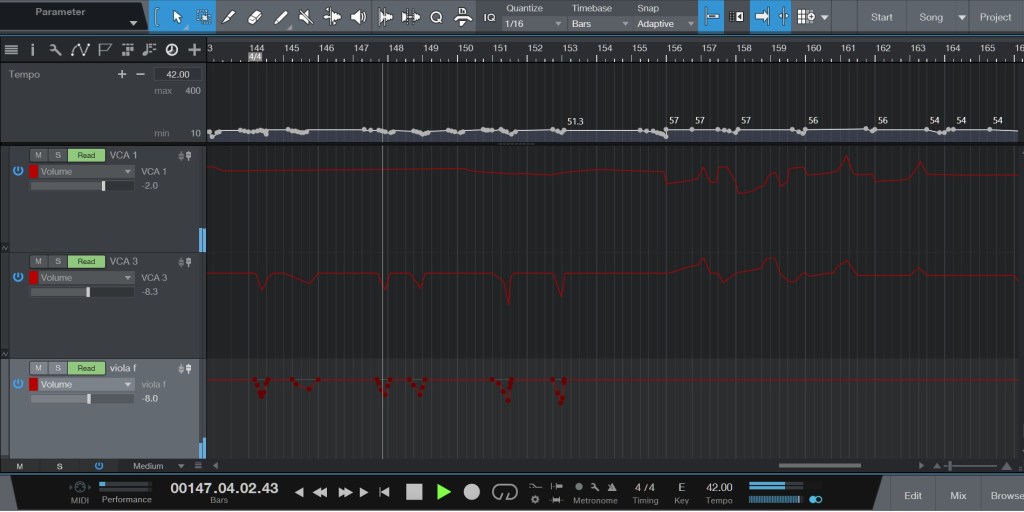
- Crescendo / Decrescendo. Wave-like changes in volume – crescendo (gradual increase) and decrescendo (gradual decrease) – create the dynamic and emotional “waves” of the orchestral texture.
- Synchronizing tempo and volume. In the tradition of Romantic interpretation accelerando (an upward movement of the tempo curve) is often accompanied by an increase in volume, while ritardando (a downward movement) is often paired with a softer dynamic. Coordinating these two curves – tempo and volume – creates the impression of natural orchestral “breathing.”
For illustration, a video fragment from Studio One can show how, in the final section, mixer volume faders slowly rise and fall with the melody, demonstrating dynamic “waves” and the effects of crescendo/decrescendo.
Rubato, crescendo/decrescendo, micro-timing, etc., are just some of the ways to bring music to life. To enhance expressiveness and realize one’s own artistic vision, there are also many other “techniques.”
Manual tempo shaping, rubato, and dynamic control remain fundamental tools of Romantic interpretation, allowing the performer to shape musical time as a living, expressive medium.
Andrei Gulaikin, February 4, 2026
 Electronica: New-age Ambient Meditation & Classical Music